Fifteen years ago today, Valve released Portal 2 — and the gaming industry has been trying to catch up ever since. The beloved 2011 puzzle game, which launched on April 18, 2011, continues to stand as a singular achievement in interactive entertainment, blending razor-sharp humor, ingenious level design, and a groundbreaking cooperative campaign into one unforgettable package. As the anniversary prompts a fresh wave of reflection, it’s striking just how few titles in the intervening decade and a half have managed to replicate what Portal 2 got so remarkably right.
One of the game’s most enduring triumphs is its comedy — a feat that, as GameSpot notes, the broader games industry still struggles to pull off convincingly. Portal 2 succeeds in large part because of its restraint. Clocking in at roughly 10.5 hours, it is remarkably lean compared to its open-world and RPG contemporaries, many of which demand dozens or even hundreds of hours from players. That brevity works in its favor: the writing never overstays its welcome, the jokes land with precision, and the pacing ensures that players are laughing rather than groaning. Other franchises like Borderlands have stumbled by flooding players with quips across sprawling runtimes, proving that sustained humor is one of the hardest things to execute in a medium built around length.
The game’s roster of characters plays an equally vital role in its comedic success. GLaDOS remains one of gaming’s greatest antagonists — dry, menacing, and perpetually hilarious — while newcomers like the bumbling Wheatley and J.K. Simmons’ bombastic Cave Johnson gave players an entirely fresh set of iconic moments. Cave Johnson’s infamous tirade about combustible lemons and the enthusiastic little robot screaming “SPAAAACE!” quickly replaced the original game’s “the cake is a lie” as the franchise’s most quoted lines, demonstrating Valve’s confidence in moving forward rather than leaning on nostalgia.
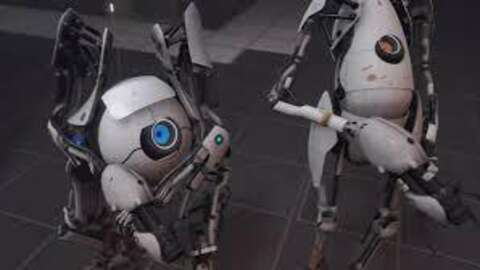
Beyond its single-player brilliance, Portal 2’s dedicated cooperative campaign was years ahead of its time in ways the industry is only now fully appreciating. The co-op mode, starring the endearing robots Atlas and P-Body, was substantial enough to function as its own standalone sequel. By doubling the portal count to four, Valve forced players to think collaboratively, coordinating complex maneuvers with precise timing. The mode also introduced contextual pinging and synchronized countdown tools — communication features that wouldn’t become mainstream until Apex Legends popularized the ping system nearly a decade later in 2019.
Atlas and P-Body themselves deserve credit for setting the template for personality-driven multiplayer characters. Their expressive animations and playful emotes predate the dance-and-gesture culture that games like Fortnite would later turn into a cultural phenomenon. Portal 2 also offered early cross-platform play, another forward-thinking feature that has only recently become an expected standard. In an era now saturated with cooperative and social gaming experiences, it’s remarkable how many of today’s conventions trace their roots back to a puzzle game from 2011.
As Portal 2 enters its sixteenth year, it remains a testament to the power of disciplined design. Valve proved that a game doesn’t need to be endlessly long or relentlessly packed with content to be unforgettable — it just needs to be smart, funny, and respectful of the player’s time. For anyone still waiting on a Portal 3, the anniversary is a bittersweet reminder: Valve may be famously reluctant to make sequels, but at least the one it delivered in 2011 has aged like few games ever have.