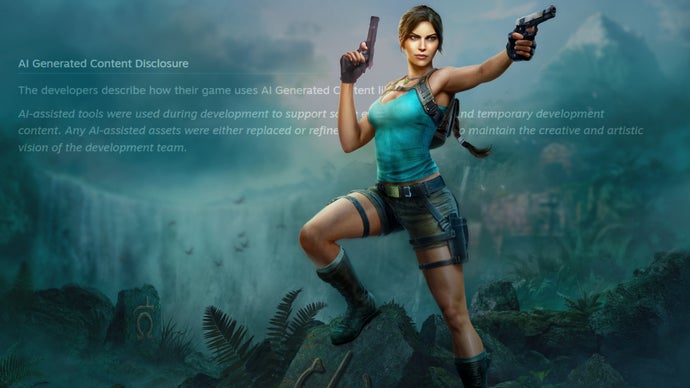
The upcoming remake of the original Tomb Raider, titled Legacy of Atlantis, has added an AI-generated content disclosure to its Steam listing following the release of a new trailer during the PlayStation State of Play showcase on June 3rd. Developed by Flying Wild Hog and Crystal Dynamics under publisher Amazon Game Studios, the game was also confirmed to have been delayed to a February 12th, 2027 release window, pushing it beyond its originally anticipated launch date.
The disclosure, which Rock Paper Shotgun notes was not present on the Steam page as recently as mid-April, states that AI-assisted tools were employed during early exploration and for temporary development content. The developers emphasized that any assets produced with AI assistance were subsequently replaced or refined by human creators to preserve the team’s creative and artistic vision.
The disclosure draws immediate comparisons to the recent controversy surrounding Crimson Desert, where developer Pearl Abyss made similar assurances about AI-generated assets being used only in a supplementary role. In that case, as Eurogamer reports, some AI-created artwork still appeared in the final release, prompting backlash from the community and a hasty promise from the studio to fix the oversight. Whether Legacy of Atlantis will avoid a similar stumble remains to be seen.
This is not the first time the Tomb Raider franchise has intersected with AI controversy. Last year, Aspyr was forced to remove AI-generated voiceover lines from Tomb Raider IV-VI Remastered after French actress Françoise Cadol pursued legal action over the unauthorized use of the technology. Adding another layer of scrutiny, Amazon Game Studios — the publisher behind Legacy of Atlantis — was the subject of a report alleging the company had instituted an internal AI mandate around mid-2024, which reportedly influenced development on at least one since-cancelled project.
The broader gaming industry continues to wrestle with whether AI disclosures should even be required. Epic Games CEO Tim Sweeney has argued that labeling games for AI use makes little sense given how widespread the technology is becoming in production pipelines. Others in the industry push back strongly against that view, with figures like former Witcher 3 game director Konrad Tomaszkiewicz warning that games built primarily with AI risk losing their creative soul. The tension between efficiency and artistic integrity shows no signs of resolving anytime soon.
Crystal Dynamics, which has weathered multiple rounds of layoffs in recent years while simultaneously developing Legacy of Atlantis and a new entry called Tomb Raider: Catalyst, will likely face continued scrutiny over its AI practices as the game approaches its 2027 launch. For now, the studio is betting that transparency and human oversight will be enough to satisfy a player base that is increasingly wary of generative AI’s role in the games they play.